


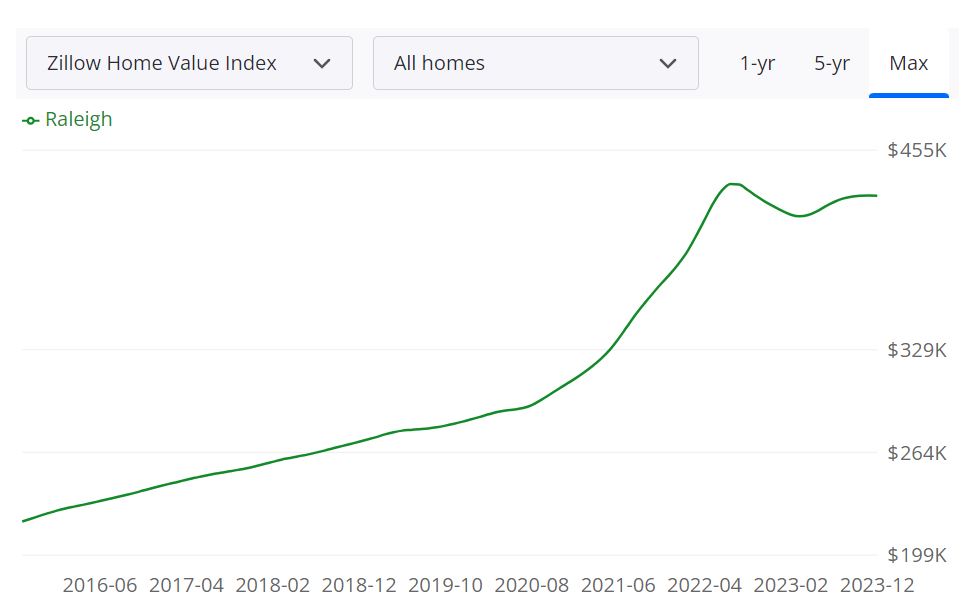
The Raleigh housing market currently leans towards being a buyer’s market, as indicated by the increased percentage of homes with price drops. The home prices in Raleigh have experienced a decline as compared to the previous year. This drop in median prices, combined with an increased number of homes with price drops, suggests a market where buyers may have more negotiating power.
Current Raleigh Housing Market Trends
Raleigh, North Carolina is a southeastern city often overshadowed by the larger Charlotte market. Raleigh, the capital city of North Carolina, is a popular destination among homebuyers due to its booming economy, excellent educational institutions, and affordable housing market.
The city is home to a large number of technology companies, including IBM, Cisco Systems, and Lenovo, making it a hub for innovation and entrepreneurship. With this growth in technology comes the need for more housing, which has led to an increase in demand for homes in Raleigh.
According to data by Redfin, the Raleigh housing market remains moderately competitive, with homes receiving an average of 2 offers and selling in approximately 46 days. As of November 2023, home prices in Raleigh experienced a 6.1% decrease compared to the previous year, resulting in a median price of $385K.
This is part of a trend where homes took slightly longer to sell than in the previous year, with 408 homes sold in November, a slight decrease from the 411 homes sold during the same period last year.
Comparative Analysis
Raleigh’s median sale price stands at 2% lower than the national average, indicating a local market that is relatively more affordable. Some homes in Raleigh receive multiple offers, with the average selling price approximately 1% below the list price. Additionally, homes tend to go pending in around 39 days on average, reflecting a slightly longer timeframe compared to the previous year. However, certain hot homes, characterized by high demand, can sell for around the list price and go pending in as little as 16 days.
Key Metrics
- Sale-to-List Price: The sale-to-list price ratio stands at 98.9%, reflecting a slight increase of 0.4 percentage points year-over-year.
- Homes Sold Above List Price: Approximately 25.0% of homes sold above the list price, indicating some properties attracting competitive bids. This percentage represents a 1.8-point decrease compared to the previous year.
- Homes with Price Drops: The percentage of homes with price drops is 36.5%, showing a 1.3-point increase year-over-year, potentially providing opportunities for buyers.
While there has been a decline in home prices, it’s important to note that the Raleigh housing market does not currently show signs of a crash. The market remains stable, with key metrics such as sale-to-list price ratio maintaining a positive trend.
Considering the current market dynamics, now might be a favorable time to buy a house in Raleigh. The buyer-friendly conditions, reflected in a lower median sale price, increased homes with price drops, and a moderate average time on the market, provide opportunities for those looking to make a purchase.
Read About North Carolina Housing Market Forecast
Raleigh Housing Market Forecast for 2024
The Raleigh housing market continues to show resilience, with the average home value reaching $427,107, reflecting a 1.6% increase over the past year. According to the forecast, there is no indication of a housing market crash. The anticipated growth in 2024 suggests continued stability in the Raleigh housing market.
Homes in Raleigh are in high demand, typically going pending in a swift 21 days. According to Zillow, as of December 31, 2023, the market has a total of 1,051 homes for sale, with 360 new listings added in the same period.
Key Metrics:
- Median Sale to List Ratio (November 30, 2023): 0.997
- Median Sale Price (November 30, 2023): $393,333
- Median List Price (December 31, 2023): $441,667
- Percent of Sales Over List Price (November 30, 2023): 32.1%
- Percent of Sales Under List Price (November 30, 2023): 49.9%
Raleigh MSA Housing Market Forecast
In terms of the Metropolitan Statistical Area (MSA) housing market forecast, Raleigh, NC, is anticipated to experience a slight fluctuation. According to data, as of December 31, 2023, the forecast suggests a -0.1% change, which is expected to stabilize and show a 0.1% increase by February 29, 2024. Looking further ahead to November 30, 2024, the forecast predicts a more significant 4.1% growth in the housing market.
The Raleigh Metropolitan Statistical Area (MSA) encompasses various counties in North Carolina. This includes Wake County, Durham County, and Johnston County, contributing to the region’s robust housing market. Raleigh’s housing market is substantial, driven by its role as a hub for technology, education, and research, making it an attractive area for both residents and investors alike.
Is Raleigh a Good Place For Real Estate Investment?
Should you invest in Raleigh real estate? If you want to find out whether Raleigh real estate is a good investment or not, you need to drill deeper into local trends. The Raleigh real estate trends will tell what the market holds for the year 2024. We have already discussed the Raleigh housing market forecast for answers on why to put invest in this market. Purchasing an investment property in Raleigh real estate is a little different from shopping for your car or primary residence.
While you still want to get the most for your money, if you are looking to make a profit, you don’t want to buy the most expensive property on the Raleigh real estate market and expect to make a good profit on rents. Perhaps you are looking for a slightly different hold-over, a turnkey investment property in Raleigh that you might move into or sell at retirement in the future! Either way, knowing your profit potential and purpose is the first thing to consider.
According to Neighborhoodscout.com, a real estate data provider, three and four-bedroom single-family detached homes are the most common housing units in Raleigh. Other types of housing that are prevalent in Raleigh include large apartment complexes, duplexes, rowhouses, and homes converted to apartments.
About a third of Americans rent their homes. In the Raleigh NC real estate market, the rate is 43%. This is partially due to the large student market, but it is also fueled by young people moving here for work. That explains why downtown Raleigh rents grew 9% in 2018. It also explains why you can rent out a studio for $900 a month and one-bedroom apartments for a thousand dollars a month.
Kiplinger, a leading publisher of business forecasts and personal finance advice, uses ATTOM Data Services to compile data on home price changes and housing affordability in the country’s top 100 markets. The affordability index indicates a city’s relative affordability (1 is the most affordable, 10 is the least affordable). It is calculated as the percentage of annual income required to purchase a median-priced home in late 2020 in each metro area. Raleigh has an affordability index of six out of ten, making it one of the most expensive cities in the United States to own a home. New York City is the most expensive city, while Augusta, Georgia is the least expensive.
To consider the prospects of investing in the Raleigh NC real estate market, we’ll focus on factors that matter to investors instead of citing the many high quality of life metrics and awards the city receives that draw new residents to the area.
The Student Market
College towns can be a great place to buy investment real estate, but the rise and fall of the flagship campus affect demand for real estate. Any state capital will be home to at least one flagship university. North Carolina State University is located here. However, the Raleigh NC real estate market for those catering to students is diversified, so to speak. Meredith College, St. Augustine’s University, and Shaw University are also located here, as are several other private religious schools.
If you invest in the Raleigh suburbs, you could attract students from Duke University in Durham and the University of North Carolina in Chapel Hill. Young people from across the globe want to experience Raleigh. From attending school at one of the local, prestigious colleges to working in the infamous Research Triangle Park, Raleigh is the new destination for young people who are interested in a fresh start and a great home to live in.
The Growing Technological Employment Base
The Research Triangle Park area consists of Raleigh, Durham, and Chapel Hill. These research centers are generating many high-tech startups and jobs, bringing people to the area for high-paying jobs. Red Hat is one of the biggest employers in the area, despite the school system, and state & local governments being major employers. The high-tech sector helps explain why Raleigh’s income per capita is roughly $33,682 while the national average is $29,829 and far above the $26,779 state average. Raleigh was ranked number one in Glassdoor’s 25 Best Cities for Jobs report.
In April, Apple announced a new campus and engineering hub that will bring many high-paying jobs to the area. The site will be located off the Triangle Expressway between Louis Stephens Drive and Davis Drive. In addition, Apple will invest $100 million to support schools and community initiatives in the Triangle and will put more than $110 million toward infrastructure in 80 North Carolina counties. In total, Apple said it will invest more than $1 billion in the state.
Raleigh’s Diverse Economic Base
Unemployment tends to be lower in areas with diverse economies. Raleigh is home to several major hospitals. It hosts an international airport. The high-tech sector is so large we’ve already mentioned it as a point in favor of the Raleigh NC real estate market. This diverse economic base protects a community from the rise and fall of employment tied to a single market sector. This explains why Raleigh’s unemployment rate was one point lower than the state average in 2018 and was three points lower than the unemployment rate for the state during the Great Recession.
The BLS reported that the unemployment rate for Raleigh fell 0.1 percentage points in July 2021 to 3.7%. For the same month, the metro unemployment rate was 0.7 percentage points lower than the North Carolina rate. The unemployment rate in Raleigh peaked in May 2020 at 12.1% and is now 8.4 percentage points lower. The relative abundance of jobs brings many to the Raleigh area, while it will keep many students graduating from their schools in the area.
Low Overall Taxes
North Carolina’s overall tax burden is roughly 30th out of the 50 states according to WalletHub. Property taxes clock in at an average of 2.3%. That’s 11th in the country but far better than a number of eastern states. Georgia’s property tax rate, for example, is 2.75%, and neighboring South Carolina’s comes in at 2.91%.
It Is Landlord Friendly
North Carolina on the whole is landlord-friendly. There are payment grace period laws, but you can charge late fees. There are no pet laws or rekeying laws in North Carolina. And unlike other states, North Carolina has been becoming more landlord-friendly. For example, a law passed in 2018 allows landlords to recover legal fees and the cost to issue a court summons when they had to go to court to evict a tenant. This isn’t a blank check, though. Recovered legal fees can’t exceed 15% of the amount owed.
Raleigh Real Estate is Relatively Affordable
North Carolina homes cost an average of $180,000. You can buy several investment properties here for the cost of one middle-class home in California or a loft in New York City. The area is so affordable that housing costs score 92 on the cost of the living index while the national average is 100. The median home value of roughly $254,000 (Zillow). NerdWallet had ranked Raleigh one of the best places to own a home. Over 70% of Raleigh’s land is zoned for residential use, which contributes to the city’s affordability of housing relative to Austin, Atlanta, and Charlotte.
The Modest Military Market
Raleigh is almost ideal in this case. The community isn’t the home of Fort Bragg, but that means the community’s real estate market won’t rise and fall based on the fate of a large base. Instead, there are several moderately sized military employers in the area. Raleigh is home to one of 65 MEPS to induct people into the military. Raleigh is home to the North Carolina National Guard, Civil Air Patrol, a US Army Corp of Engineers, and an Army Research Office. An office of the Defense Criminal Investigative Service is located here, as well.
References
Market Trends And Forecast
https://www.zillow.com/raleigh-nc/home-values
https://www.trianglemls.com/tmls/market-trends/
https://www.realtor.com/local/Raleigh_NC
https://www.redfin.com/city/35711/NC/Raleigh/housing-market
http://www.homesinraleigh.org/raleigh-housing-report.html
http://www.metrodepth.com/raleigh-forecast-another-average-year
http://www.freddiemac.com/research/indices/house-price-index.page
Rental Market
www.zumper.com/rent-research/raleigh-nc
www.bestplaces.net/housing/city/north_carolina/raleigh
www.rentcafe.com/average-rent-market-trends/us/nc/raleigh
https://www.apartmentlist.com/renter-life/average-rent-in-raleigh
Universities and demographics
www.en.wikipedia.org/wiki/Raleigh,_North_Carolina
Higher average income
www.areavibes.com/raleigh-nc/employment
Tax rates
www.wallethub.com/edu/states-with-highest-lowest-tax-burden/20494/
Landlord friendly
www.portcitydaily.com/local-news/2018/06/30/heres-how-north-carolinas-new-eviction-fee-law-changes-things-for
Landlords-and-tenants
www.avail.co/education/laws/north-carolina-landlord-tenant-law
Military market
www.mepcom.army.mil/Units/Eastern-Sector/ 12th-Battalion/Raleigh
