


If the Federal Reserve raises rates this afternoon — the outcome markets still assign roughly a 93% to 94.5% probability ahead of the Wednesday, September 16, 2026 decision around 2:00 p.m. ET — the headline will be a tidy 25 basis points. The household experience will not be tidy. Lower-income consumers tend to carry more expensive revolving debt, rely more on variable-rate products, and have less cash buffer when a payment steps up. A hike that looks “small” on cable news can feel large in a checking account that was already thin.
This piece does not claim the vote is finished. It maps the transmission channels that usually hit lower-income borrowers hardest when the federal funds rate rises, and what you can still control before and after the statement.
How Today’s Looming Federal Reserve Rate Hike Will Disproportionately Impact Lower Income Consumers
Monetary policy is often described as a blunt instrument. That bluntness is not evenly distributed. Households with high incomes and large fixed-rate mortgages can shrug off a quarter-point move in overnight rates. Households revolving credit-card balances near the limit, financing a used car at a steep APR, or sitting on a HELOC tied to prime feel the same policy shift as a budget event.
For the macro debate around whether hiking today is wise, see why leading economists warn this hike could be a policy mistake. For the low-odds alternative, see what happens if the Fed shockingly holds.
Why the same 25 bp hike is not the same payment shock
Three structural facts drive the disproportionate impact:
- Debt mix: Lower-income households often have a higher share of balances in credit cards and other high-APR consumer credit
- Rate type: Variable-rate products (cards, many HELOCs, some personal loans, certain ARMs) reprice when prime and related indexes move with the Fed
- Buffer: Smaller emergency savings mean a $30–$80 monthly step-up is harder to absorb without cutting essentials or taking on more debt
| Channel | How a Fed hike typically transmits | Why lower-income households feel it more |
|---|---|---|
| Credit cards | Prime often moves with funds rate; APRs adjust | Higher revolving utilization; fewer payoff options |
| Auto loans | New loans reprice; existing fixed loans less so | Larger payment share of income; thinner credit tiers |
| Mortgages (fixed) | Indirect via longer yields / lender spreads | Payment stress if already housing-cost burdened |
| ARMs / HELOCs | Index + margin resets | Less ability to refinance or pay down principal |
| Variable personal loans | Contractual rate resets | Fewer alternative credit lines |
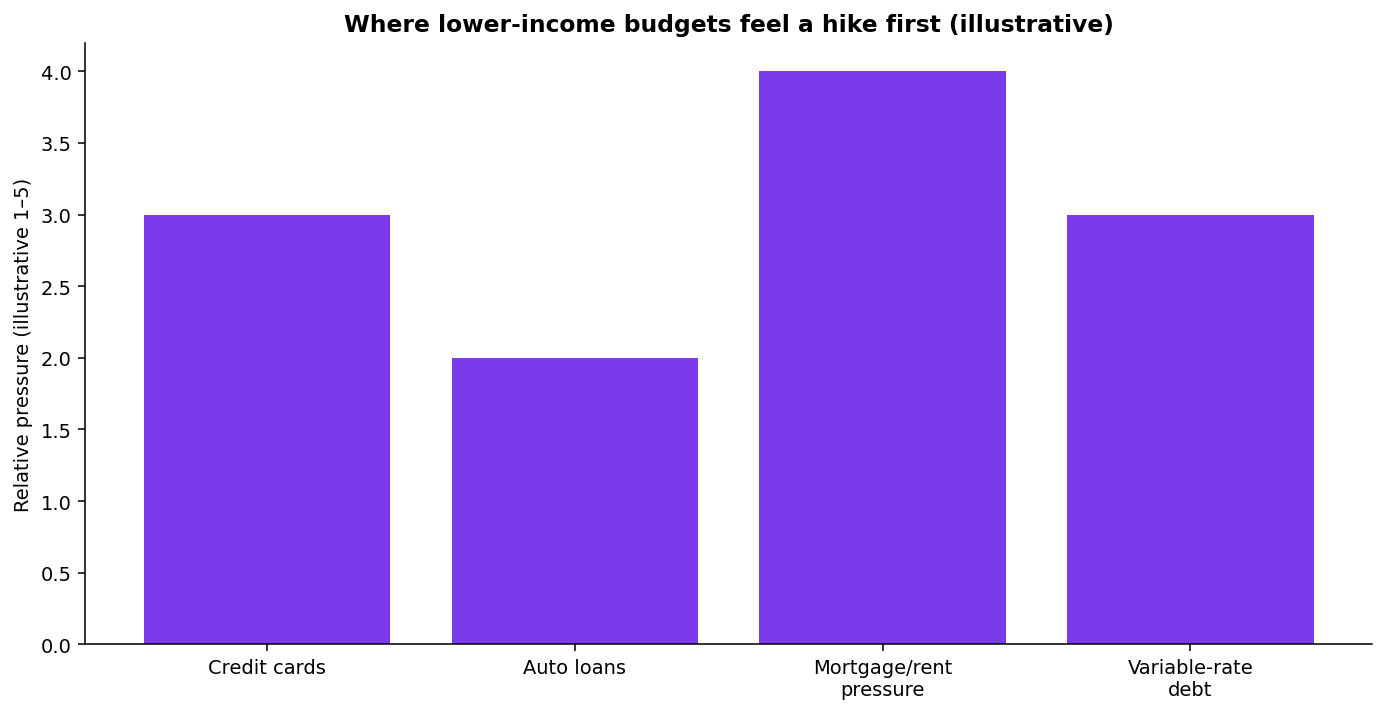
Credit cards: the fastest household transmission
Credit cards are where many families feel Fed policy first. Card APRs commonly reference prime, and prime has historically moved in lockstep with the federal funds target. If the FOMC delivers the widely expected hike later today, card issuers can raise variable APRs on a schedule spelled out in your agreement — not always overnight, but often soon enough to matter on the next statement cycle.
- Minimum payments can rise when interest accrues faster on the same balance
- Households making only minimums see more of each payment eaten by interest
- Balance-transfer and 0% promo expirations become more painful in a higher-rate regime
Practical framing (not advice): If you carry a revolving balance, know your APR, whether it is variable, and when the issuer posts rate changes. A single 25 bp move is incremental; a sequence of hikes is cumulative — and lower-income borrowers are more likely to still be carrying balances from the last cycle of price shocks in food, rent, and insurance.
| Credit-card pressure point | What to check today | Why it matters after 2 p.m. ET |
|---|---|---|
| Purchase APR type | Variable vs fixed language in terms | Variable APRs can follow prime higher |
| Current utilization | Balance ÷ credit limit | High utilization + higher APR compounds fast |
| Promo end date | 0% or teaser windows | Post-promo APR may already be elevated |
| Minimum payment math | Interest vs principal split | Small APR rise can lengthen payoff time |
Auto loans: new credit vs loans you already signed
Most traditional auto loans are fixed-rate once originated. That means yesterday’s loan payment does not automatically jump because the Fed meets today. The disproportionate hit shows up elsewhere:
- New and refinanced auto credit gets more expensive when funding costs and risk premiums rise
- Subprime and deep-subprime borrowers already pay wider spreads; a tighter policy stance can widen access gaps
- Dealer “backend” products and longer loan terms can mask payment stress until something breaks — job loss, repair bill, or insurance spike
Lower-income households are more likely to need a car to reach work with limited transit options. When monthly auto + insurance + maintenance already rival rent in some metros, even a modest rise in new loan APRs reduces replacement options and keeps people in older, costlier-to-maintain vehicles.
Mortgages: fixed-rate insulation vs ARM and HELOC exposure
A 30-year fixed mortgage is partial insulation from today’s decision. Your rate is your rate until you refinance or sell. The catch for lower-income owners and buyers:
- Would-be buyers face affordability math that mixes price, insurance, taxes, and the mortgage rate — a Fed hike can firm the “higher for longer” narrative even if the 10-year barely moves today
- ARM borrowers can see resets tied to indexes that ultimately reflect Fed policy
- HELOC and home-equity debt often floats with prime; using a home as a revolving facility becomes costlier when policy tightens
Renters are not “safe” either. Landlords facing higher floating-rate property debt or refinancing walls may push rents where local markets allow — another indirect channel that hits lower-income households harder as a share of income.
| Housing debt type | Sensitivity to today’s decision | Lower-income angle |
|---|---|---|
| 30-year fixed (existing) | Low direct | Still vulnerable via taxes/insurance/HOA inflation |
| Purchase / refi shopping now | Medium (market rates) | Payment-to-income ratios tighter |
| ARM nearing reset | High over reset window | Fewer refinance escape hatches |
| HELOC / variable equity line | High if prime moves | Debt often layered on thin cash flow |
Variable-rate debt: the quiet budget leak
Beyond cards and HELOCs, watch any product priced off prime, SOFR, or a Treasury bill index:
- Some personal loans and credit lines
- Margin or portfolio lines (less common for lower-income households, but relevant for mixed-income families)
- Certain student credit products and private loans with variable schedules
The pattern is consistent: variable rate + high utilization + low liquidity = outsized pain from a hike that wealthier households barely notice.
The income and wealth buffer gap
Disproportionate impact is not only about APRs. It is about what happens when a payment rises:
- Cut discretionary spending — possible if there is discretionary spending left
- Delay maintenance or medical care — a common, costly coping pattern
- Add hours / gig work — income volatility rises
- Revolve more debt — interest compounds the original shock
Higher-income households more often choose (1). Lower-income households more often face (2)–(4). That is the distributional story behind a “small” 25 bp move.
What you can still do on decision day (factual checklist)
- List every variable-rate balance (card, HELOC, ARM index) and the next reset or statement date
- Pay more than the minimum on the highest-APR revolving debt if cash flow allows — reducing principal shrinks the base the new APR applies to
- Avoid new high-APR originations today purely because of headlines; shop terms, not panic
- If buying a home: separate the Fed drama from your lender lock; ask for updated quotes after the statement rather than guessing
- Build a tiny cash buffer first if you have none — even a small reserve reduces the odds that a rate step-up becomes a payday-loan spiral
How this ties to the broader September 16 setup
Markets still treat a hike as the base case until the statement prints. Hawks frame the move as necessary credibility. Critics argue that if inflation is partly a supply story, demand-side tightening lands hardest on people with the least slack — the same households this article focuses on. Kevin Warsh’s widely circulated line that “inflation is a choice” captures one side of that debate; the distributional costs of the choice show up in card statements and car notes.
Bottom line
A looming Fed hike does not hit every consumer equally. Lower-income households feel credit cards, auto credit conditions, ARMs, HELOCs, and other variable-rate debt more intensely because those products are a larger share of fragile budgets. Watch the 2:00 p.m. ET statement for the official target range — then translate it into your own APR list, not into abstract basis points.
Strong Returns With Turnkey Rentals Despite Fed Uncertainty
The Fed’s rate decisions can create market volatility, but turnkey rentals continue to deliver reliable cash flow and appreciation. Investors in 2026 are focusing on real estate as a hedge against uncertainty.
Norada Real Estate helps you secure turnkey properties designed for immediate income and long‑term growth—so your portfolio stays strong regardless of Fed policy shifts.
🔥 HOT INVESTMENT LISTINGS JUST ADDED! 🔥
Speak with an Investment Counselor Today (No Obligation):
(800) 611-3060
Or Request a Callback / Fill Out the Form Online
Want to Know More?
Explore these related articles for even more insights:
