


In the Houston Housing Market for September 2023, home sales took a significant hit, marking the 18th consecutive month of declining sales. This decline can be attributed to the impact of interest rates, which led prospective homebuyers toward the rental market and caused others to postpone their buying plans.
However, the slower sales did result in an expansion of inventory and moderated prices, creating a more favorable environment for buyers once consumer confidence is restored. 1-year market forecast for Houston as of September 30, 2023, projects a modest increase of 0.3% in home prices.
Key Statistics
- Houston Housing Market: The Houston Association of Realtors’ (HAR) September 2023 Market Update reveals that single-family home sales decreased by 10.9 percent year-over-year, with 6,886 units sold compared to 7,728 in September 2022.
- Inventory Expansion: The months supply of homes climbed to 3.5, the highest level since November 2019 when it was at a 3.6-month supply.
- Pre-Pandemic Comparison: Compared to pre-pandemic September 2019, when home sales totaled 7,050, the sales were down by 2.3 percent.
All segments of the housing market experienced declines in September, except for the sub-$100,000 market, which remained statistically flat. Rental homes, including single-family homes and townhomes/condominiums, continued to attract strong interest from consumers.
As the holidays approach, it’s expected that the real estate market in Houston will remain sluggish. Rental homes are likely to continue drawing interest from consumers as potential buyers remain cautious about mortgage rates.
Single-family home prices continued to moderate, with the average price increasing by just 0.8 percent to $416,664, while the median price fell by 2.2 percent to $333,000. These figures are significantly below the record highs seen in May and June of 2022.
September marked the 18th consecutive month of negative sales activity, with single-family home sales falling by 10.9 percent year-over-year. Total property sales and total dollar volume also declined compared to the previous year. However, single-family pending sales saw a modest increase of 1.2 percent, and active listings were 13.7 percent higher than in 2022.
The months of inventory expanded in September to a 3.5-month supply, the highest level since November 2019 when it was at a 3.6-month supply. This increase in inventory may provide more options for prospective homebuyers.
Single-Family Homes Update
In September, single-family home sales dropped by 10.9 percent year-over-year. The average price inched up by 0.8 percent to $416,664, while the median price decreased by 2.2 percent to $333,000. For context, September 2023 closings were 2.3 percent below September 2019 figures, but prices have seen significant increases compared to 2019.
Townhouse/Condominium Market
Townhouses and condominiums experienced their 16th straight monthly decline in September, with sales dropping by 14.4 percent year-over-year. The average price remained relatively stable at $257,909, while the median price saw a modest increase of 2.2 percent to $224,250. Inventory for townhouses and condominiums expanded to a 3.5-month supply, the highest level since November 2020.
Houston Real Estate Highlights in September
- Single-family home sales declined by 10.9 percent year-over-year, marking the 18th consecutive month of slowing sales volume.
- Days on Market (DOM) for single-family homes increased from 37 to 45 days.
- Total property sales fell by 9.5 percent, with 8,550 units sold.
- Total dollar volume dropped by 9.6 percent to $3.3 billion.
- The single-family median price fell by 2.2 percent to $333,000, while the single-family average price rose by 0.8 percent to $416,664.
- Single-family home months of inventory registered a 3.5-month supply, up from 2.6 months a year earlier – the biggest supply since November 2019.
- Townhome/condominium sales experienced their 16th straight monthly decline, falling by 14.4 percent.
Houston Housing Market Forecast 2023-2024
Looking at the current statistics, what are the Houston real estate market predictions? NeighborhoodScout.com’s data also shows that Houston real estate appreciated by nearly 98.71% over the last ten years. Its annual appreciation rate has been averaging 7.11%. This figure puts it in the top 30% nationally for real estate appreciation.
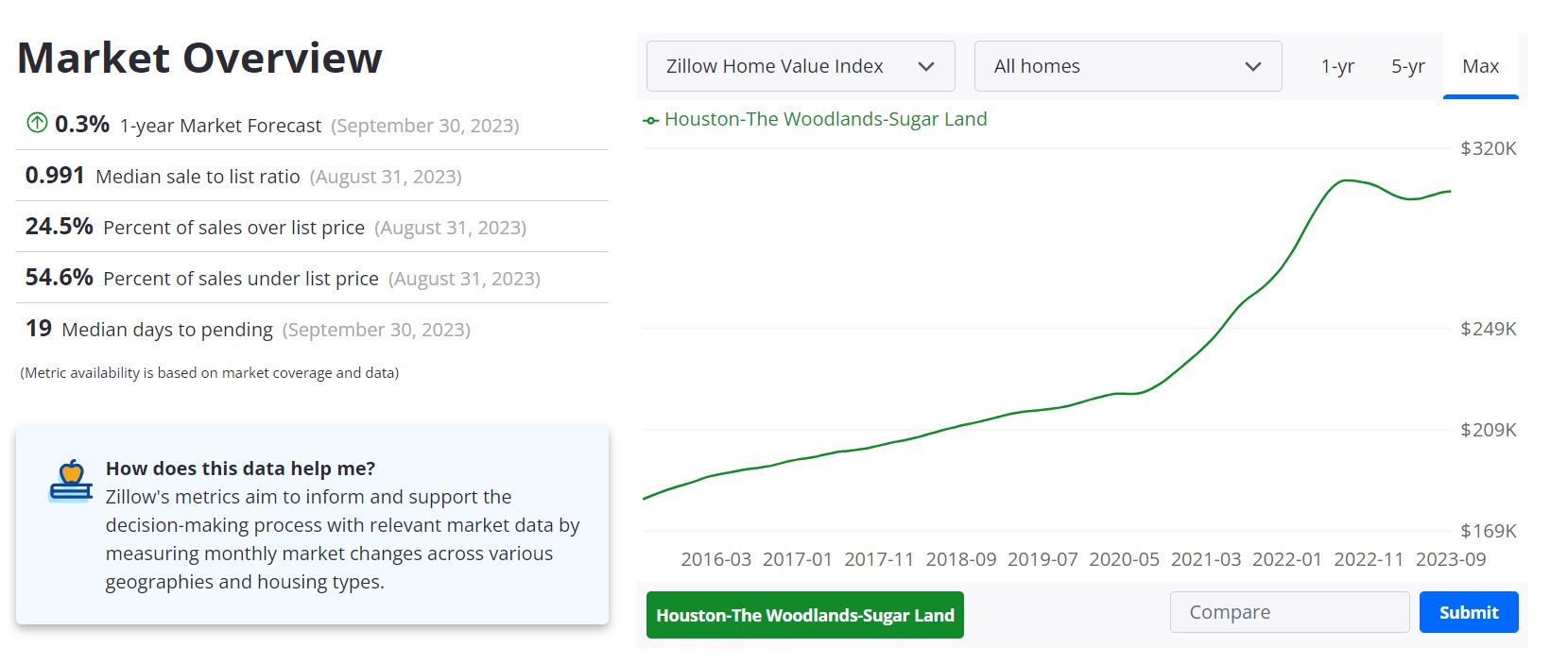
The Houston housing market is always a subject of great interest, and Zillow’s insights provide valuable information on the current state and future prospects.
Current Home Values
As of the most recent data available, the average home value in the Houston-The Woodlands-Sugar Land area stands at $303,772. Over the past year, there has been a slight decrease of 1.4% in home values, which is a significant metric for both buyers and sellers. These figures offer a snapshot of the current market conditions in the region, providing a starting point for understanding the local real estate landscape.
Market Forecast
Zillow’s 1-year market forecast for Houston as of September 30, 2023, projects a modest increase of 0.3%. This forecast offers a glimpse into the market’s short-term trajectory, indicating that there might be some positive movement in the near future. Homebuyers and sellers can use this information to make informed decisions about their real estate endeavors.
Market Dynamics
Several key statistics shed light on the dynamics of the Houston housing market. These metrics are pivotal in determining whether it’s a buyer’s or seller’s market.
- Median Sale to List Ratio (August 31, 2023): The median sale to list ratio, which stands at 0.991, indicates that, on average, homes in Houston are selling very close to their list prices. This suggests a balanced market where both buyers and sellers have room for negotiation.
- Percent of Sales Over List Price (August 31, 2023): At 24.5%, nearly a quarter of home sales in Houston are transacting above the list price. This may indicate strong demand and competitive bidding, which is advantageous for sellers.
- Percent of Sales Under List Price (August 31, 2023): On the flip side, 54.6% of home sales are occurring under the list price. This data suggests that buyers also have opportunities to find homes at a price lower than the listing, potentially creating a buyer’s market for certain properties.
- Median Days to Pending (September 30, 2023): Homes in Houston are going pending in approximately 19 days. This quick turnaround time is indicative of a competitive market where buyers need to act swiftly.
The State of the Houston Housing Market
So, are housing prices going down in Houston? The data shows a slight decrease over the past year, but Zillow’s 1-year market forecast suggests a potential rebound. This creates an environment where buyers may find opportunities, but sellers can still achieve favorable outcomes.
Is Houston, TX, a buyer’s or seller’s market? The answer is nuanced. The median sale to list ratio indicates a balanced market, while the percentage of sales above and below list price suggests both buyer and seller advantages depending on specific circumstances.
Ultimately, the Houston housing market is dynamic, offering something for everyone. Whether you’re buying or selling, understanding the local market conditions and keeping an eye on forecasts is essential for making informed decisions in the ever-evolving real estate landscape.
Houston Real Estate Market Statistics (Previous Year)
The Houston real estate market in 2022 saw record-high average and median prices, but also declining sales, particularly due to a lack of inventory and rising mortgage rates. June had the year’s strongest sales volume with 9,844 single-family units sold. Despite this, new listings gave a boost to inventory levels, which hit a high of 2.8 months in October and November.
In total, 95,113 single-family homes were sold in 2022, representing a 10.9% decrease from the previous year, while the average and median prices increased by 10% and 12.8%, respectively. According to HAR’s December/Full-Year 2022 Housing Market Update, single-family home sales fell 10.9 percent to 95,113.
Sales of all property types totaled 117,572, down 10.7 percent from 2021. Total dollar volume dropped just 2.0 percent to $45.6 billion versus $46.5 billion in 2021. The lease market remained strong as many prospective buyers opted to rent until they were ready to buy.
Houston Rental Market Trends
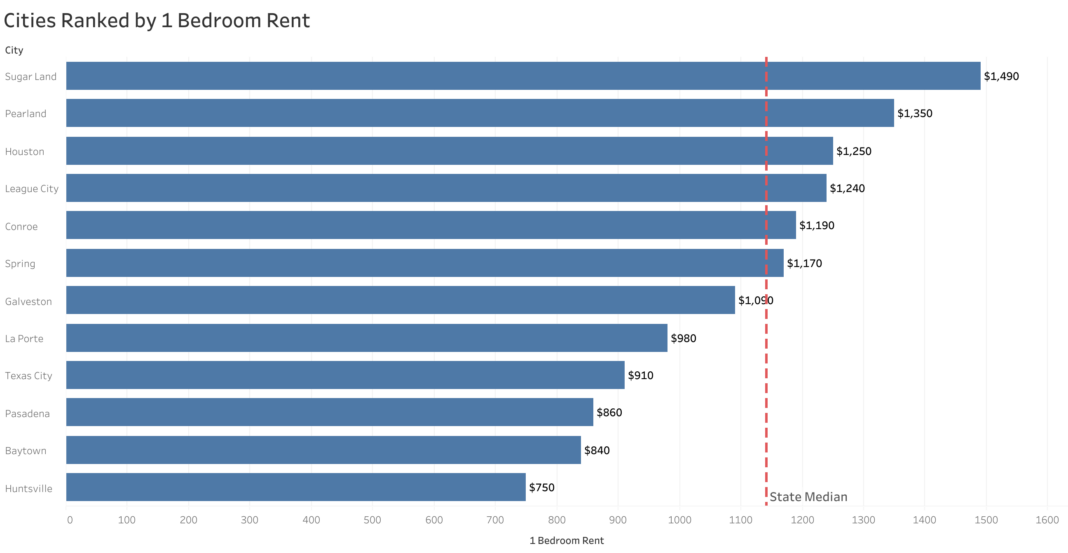
The Zumper Houston Metro Area Report analyzed active listings last month across the metro cities to show the most and least expensive cities and cities with the fastest growing rents. The Texas one bedroom median rent was $1,141 last month. Sugar Land was the most expensive cities with one bedroom priced at $1,490. Huntsville was the most affordable city with rent at $750.
The Fastest Growing Cities For Rents in Houston Metro Area (Year-Over-Year)
- Huntsville had the fastest growing rent, up 25% since this time last year.
- Galveston saw rent climb 18.5%, making it second.
- Pearland was third with rent increasing 13.4%.
The Fastest Growing Cities For Rents in Houston Metro Area (Month-Over-Month)
- League City experienced the largest monthly rent price growth rate, jumping 6%.
- Conroe was second with rent climbing 3.5%.
- Sugar Land ranked as third with rent growing 2.1%.
As of July 2023, the average rent for a 1-bedroom apartment in Houston is currently $1,279. This is a 2% decrease compared to the previous year. Over the past month, the average rent for a studio apartment in Houston increased by 2% to $1,280. The average rent for a 1-bedroom apartment increased by 2% to $1,279, and the average rent for a 2-bedroom apartment remained flat.
- Two-bedroom apartment rents average $1,545 (a 1% decrease from last year).
- Three-bedroom apartment rents average $1,800 (a 4% decrease from last year).
- Four-bedroom apartment rents average $2,025 (a 7% decrease from last year).
Some of the most affordable neighborhoods where the asking prices are below the average Houston rent:
- East Little York, where the average rent goes for $870/month.
- Greater Eastwood, where renters pay $850/mo on average.
- Gulfton, where the average rent goes for $1160/mo.
Houston Real Estate Investment Outlook
The city of Houston has long been a beacon for real estate investors seeking opportunities for long-term growth. As one of the largest and most dynamic cities in the United States, Houston offers a unique landscape for those looking to make strategic real estate investments. In this essay, we’ll explore the factors that make Houston a promising destination for long-term real estate investment and provide insights into its outlook for sustainable growth.
Economic Resilience
One of the fundamental factors that underpin Houston’s real estate investment potential is its economic resilience. Houston is home to a diverse range of industries, including energy, healthcare, manufacturing, and aerospace. Its role as the energy capital of the world has historically been a significant driver of economic activity.
While energy markets can be cyclical, Houston’s economy has shown remarkable resilience even in the face of energy price fluctuations. This economic diversity serves as a stabilizing force for real estate investors, reducing the risk associated with economic downturns in any single sector.
Population Growth
Houston has consistently experienced population growth over the years. This demographic expansion is driven by several factors, including a robust job market, affordable housing, and a high quality of life. The city’s attractiveness to both domestic and international migrants bodes well for long-term real estate investment. As the population continues to grow, the demand for housing and commercial properties is expected to follow suit, creating a reliable source of rental income and property appreciation for investors.
Infrastructure Development
Houston has made significant investments in infrastructure development. The city’s commitment to improving transportation, public amenities, and urban planning has enhanced its livability and attractiveness. Infrastructure investments not only make the city a better place to live but also contribute to increasing property values. As Houston continues to expand and modernize its infrastructure, investors can expect to see a positive impact on their real estate holdings in the long term.
Real Estate Diversity
Houston’s real estate market offers a diverse range of investment opportunities. Whether you’re interested in residential, commercial, industrial, or mixed-use properties, Houston has options to suit various investment strategies. The city’s size and varied neighborhoods provide investors with choices to tailor their portfolios to their specific goals. This diversity allows for risk mitigation through portfolio diversification, a key strategy for long-term real estate investors.
Top 10 Highest Appreciating Neighborhoods in Houston
- Gulfgate Riverview Pine Valley East
- Lawndale Wayside South
- Downtown Southeast
- Gulfton South
- Second Ward East
- Close In
- Second Ward
- Greenway Upper Kirby Area West
- Second Ward West
- South Main
(List by Neighborhoodscout.com)
Conclusion: Houston’s Promise for Long-Term Real Estate Investment
When considering the outlook for long-term real estate investment, Houston stands out as a city with immense potential. Its economic resilience, population growth, infrastructure development, and real estate diversity create a fertile ground for investors seeking sustainable and reliable returns. The city’s track record of weathering economic challenges and its proactive approach to urban development positions it as an attractive destination for those who value long-term real estate investments. As Houston continues to evolve and expand, it will likely remain a shining star in the constellation of real estate investment opportunities.
References:
- https://www.har.com/content/mls
- https://www.zillow.com/houston-tx/home-values
- https://www.neighborhoodscout.com/tx/houston/real-estate
- https://www.realtor.com/realestateandhomes-search/Houston_TX/overview
