The California housing market is currently navigating a complex period, with sales figures showing a slight dip in March and median prices experiencing modest year-over-year growth. Looking ahead, experts anticipate a continued, albeit gradual, recovery and stabilization, with significant regional variations and a strong influence from interest rates and inventory levels shaping the California housing market trends and forecast for 2026.
California Housing Market: What’s Happening Now in 2026
The Current State of Play: A March Snapshot
Let’s talk about what’s happening right now. In March, we saw existing, single-family home sales total around 265,320 units on a seasonally adjusted basis. That’s a bit lower than February and also a touch down from March of last year. This means fewer homes are changing hands compared to the previous year, and it’s been happening for a few months now.
The median home price, however, tells a slightly different story. In March, it climbed to about $889,190. This is a solid jump from February, which is pretty typical for this time of year as we head into spring. More importantly for year-over-year comparisons, the median price is up a small 0.4% from March 2025. While it’s not a huge surge, it shows that prices are holding their ground, and in some areas, they are actually creeping up.
Key Takeaways from March 2026 Data:
- Sales Decline: Existing single-family home sales were down 3.5% from February and 2.5% from March 2025.
- Price Resilience: The statewide median home price increased 7.1% from February and saw a modest 0.4% year-over-year gain.
- Inventory Crunch: The number of homes available for sale remains low, a major factor in price stability.
Why the Sluggish Sales? Geopolitics and Rates
So, why aren’t more homes selling? The report points to a few big reasons. Geopolitical tensions, like the situation in the Middle East, can make people nervous. When the world feels uncertain, folks tend to hold onto their money and put big decisions, like buying a house, on pause. This uncertainty, combined with rising mortgage rates, is keeping potential buyers and sellers in a “wait-and-see” mode.
It’s like when there’s bad weather forecast – you might delay your picnic. In housing, that “bad weather” is a mix of global worries and the increasing cost of borrowing money. When mortgage rates tick up, it makes monthly payments higher, and that can push some buyers out of the market or force them to look for less expensive homes.
The “Lock-in Effect”: A Silent Inventory Killer
One of the most significant factors impacting the market right now is what economists call the “lock-in effect.” A huge number of homeowners secured historically low mortgage rates over the past few years. Now, with current rates much higher, they’re hesitant to sell their current homes because buying a new one would mean taking on a much larger mortgage payment.
Imagine you have a fantastic deal on something you love. Would you give it up for a much more expensive replacement, even if the replacement is new? Probably not. This reluctance to sell means that fewer homes are coming onto the market, which, in turn, keeps prices from dropping significantly. It’s a bit of a Catch-22: low inventory supports prices, but it also limits the number of sales happening.
Regional Differences: Not All California is the Same
It’s crucial to remember that California is a massive and diverse state. What’s happening in San Francisco is very different from what’s happening in the Central Valley or Southern California.
- San Francisco Bay Area: This region, known for its high prices, saw its median home price remain stable year-over-year in March, at a staggering $1.4 million. Sales, however, did see a modest increase.
- Southern California: This vast area experienced a slight uptick in both sales and median prices.
- Central Coast: This area saw a dip in median prices, while sales increased.
- Central Valley and Far North: These regions showed the strongest year-over-year sales gains, though starting from lower price points.
These differences highlight how local economies, job markets, and housing supply all play a significant role in shaping the market’s performance in different parts of the state.
My Take: It’s a Market of Nuance
From my perspective, the California housing market is far from a simple narrative. It’s a story of resilience in the face of economic headwinds and a testament to the enduring desire for California living. While sales might be a bit slow right now, the underlying demand is still there. The future isn’t about a dramatic boom or bust, but rather a gradual rebalancing where affordability, inventory, and interest rates will dictate the pace. Keeping a close eye on these factors will be essential for anyone looking to navigate this dynamic market in the coming years, especially as we head towards 2026.
California Housing Market Forecast: What to Expect in 2026
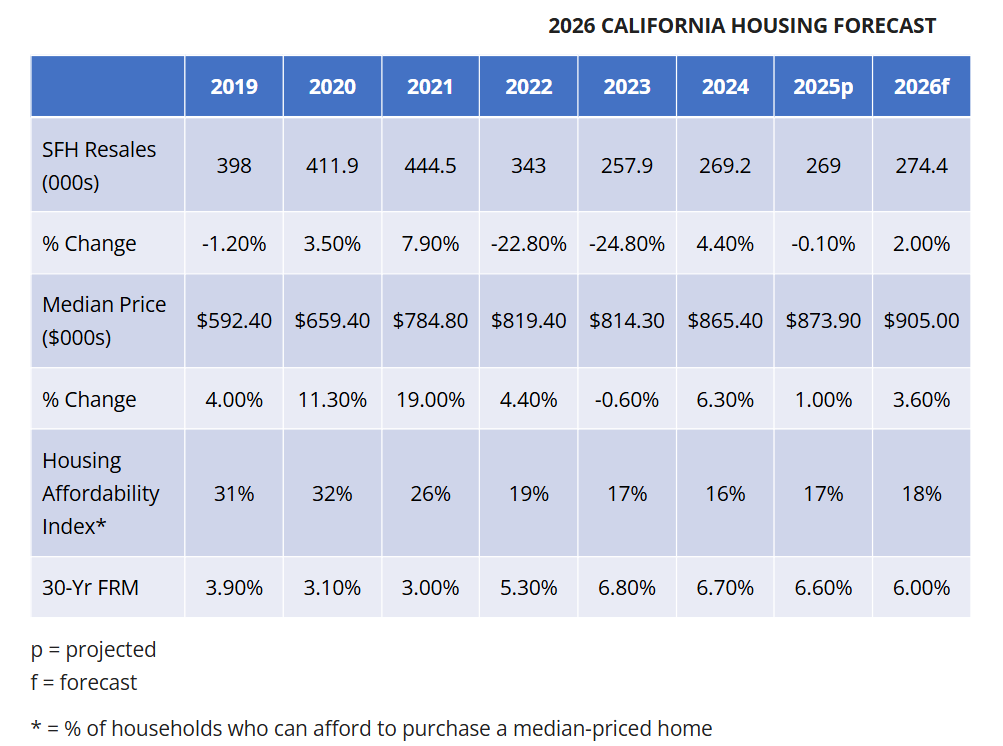
The California housing market is poised for a gentle upturn in 2026, with home sales and the median price expected to inch up slightly. According to the CALIFORNIA ASSOCIATION OF REALTORS® (C.A.R.), we can anticipate existing single-family home sales to reach around 274,400 units, a 2% increase from 2025. The median home price is projected to hit a new record, climbing 3.6% to $905,000. While this might sound like a straightforward prediction, dig a little deeper, and you’ll find a more nuanced picture shaped by economic shifts, interest rates, and a slowly improving affordability situation.
My Take on the 2026 Outlook
As someone who’s been following the California real estate scene for a while, I can tell you that “inching up” feels like a pretty accurate description. We’ve seen some wild swings in the past, and frankly, a period of relative stability is what many buyers and sellers are hoping for. C.A.R.’s forecast suggests that stability is on the horizon, but it’s not going to be a free-for-all. Affordability is still a major hurdle, but there are glimmers of hope.
A Look at C.A.R.’s Projections
Let’s break down what C.A.R. is predicting for the coming years:
| Year | SFH Resales (000s) | % Change | Median Price ($) | % Change | Housing Affordability Index (%) | 30-Yr FRM (%) |
|---|---|---|---|---|---|---|
| 2024 | 269.2 | 4.40% | $865,400 | 6.30% | 16% | 6.70% |
| 2025p | 269.0 | -0.10% | $873,900 | 1.00% | 17% | 6.60% |
| 2026f | 274.4 | 2.00% | $905,000 | 3.60% | 18% | 6.00% |
p = projected, f = forecast
As you can see, 2025 is looking like a bit of a holding pattern, with sales essentially flat compared to 2024. However, the median price is still expected to tick up slightly. The real movement, according to this forecast, is in 2026, where we see both sales and prices showing more noticeable, albeit still moderate, growth.
Why the Gentle Climb?
Several factors are expected to contribute to this gradual ascent:
- Interest Rates Cooling Down: This is a big one. C.A.R. forecasts the average 30-year fixed mortgage rate to drop to 6.0% in 2026. This is a significant improvement from the averages seen in recent years and even the 6.6% projected for 2025. Lower mortgage rates mean more buying power for consumers. Even though it’s still higher than pre-pandemic levels, it’s a move in the right direction and, importantly, lower than the 50-year historical average of nearly 8%.
- Slightly Better Affordability: With lower interest rates and potentially moderate price gains, housing affordability is predicted to inch up. The index is expected to reach 18% in 2026, meaning 18% of households will be able to afford to buy a median-priced home. This is a small but welcome improvement from 16% in 2024 and 17% in 2025. For many Californians, this slight shift could make the dream of homeownership feel a bit more attainable.
- Increasing Inventory: The forecast indicates that housing supply will continue to improve, with active listings potentially rising by nearly 10% in 2026. When more homes are available, it can ease some of the intense competition we’ve seen in the market. This could give buyers a bit more breathing room and potentially moderate intense bidding wars.
What About the Economy?
The housing market doesn’t exist in a vacuum. The broader economic picture plays a crucial role.
- Slowing GDP Growth: The U.S. gross domestic product (GDP) is expected to grow at a slower pace in 2026, around 1%, after a projected 1.3% in 2025.
- Job Growth and Unemployment: California’s nonfarm job growth is also projected to slow down, with a 0.3% increase in 2026 after a 0.4% rise in 2025. Consequently, the unemployment rate is expected to creep up to 5.8% in 2026 from 5.6% in 2025 and 5.3% in 2024. While a slight increase in unemployment can be concerning, these numbers suggest the job market, while cooling, isn’t collapsing.
C.A.R. President Heather Ozur points out that as economic uncertainty begins to clear and mortgage rates decline, housing sentiment should improve. This is a key piece of the puzzle – people are more likely to make big financial decisions like buying a home when they feel more secure about their jobs and the economy.
Potential Roadblocks and Challenges
It wouldn’t be wise to paint an entirely rosy picture. The forecast also highlights several challenges that could still impact the market:
- Inflation: Inflation is likely to pick up, with the annual average Consumer Price Index (CPI) expected to reach 3.0% in 2026, up from 2.8% in 2025. Higher inflation can erode purchasing power and impact what people can afford.
- Home Insurance Crisis: The ongoing issues with homeowners insurance in California are a significant concern. Rising premiums and reduced availability of coverage can make homeownership more expensive and less attractive, especially in fire-prone areas.
- Trade Tensions: Lingering trade tensions between the U.S. and its trading partners can create economic uncertainty, which can ripple through the housing market.
- Stock Market Volatility: A potential stock market bubble could burst, leading to financial instability and affecting the confidence of high-net-worth individuals who are often significant players in luxury real estate markets.
Senior Vice President and Chief Economist Jordan Levine notes that despite these headwinds, the improving lending environment and clearing economic clouds will be key drivers.
What This Means for You
So, what does all this forecast talk mean for you, whether you’re looking to buy, sell, or just keep an eye on your investments?
- For Buyers: The forecast offers a glimmer of hope. Lower interest rates and a slight increase in inventory in 2026 could make it a more favorable year for buyers than the preceding ones. However, affordability remains a challenge, so smart financial planning and patience will still be crucial. Don’t expect a crash, but rather a market that might be slightly less of a seller’s dominance.
- For Sellers: If you’ve been holding off, 2026 might present a more opportune time to list your home. With stabilizing prices and rising demand, you could see your property fetch a good price. However, the days of astronomical offers might be behind us, and a more realistic pricing strategy will be important.
- For Homeowners: If you own a home in California, the moderate price appreciation suggests that your home equity is likely to continue growing, albeit at a steadier pace than in boom years.
My personal feeling is that California’s housing market, given its fundamental strengths in desirability and economic output, will continue to be resilient. The forecast for 2026 suggests a return to a more sustainable growth pattern. It’s not a market for speculators looking for quick flips, but for those looking for long-term value and a place to call home, opportunities will likely emerge.
The key takeaway from C.A.R.’s 2026 California Housing Market Forecast is that we’re looking at a period of gradual improvement. Sales and prices are projected to rise modestly, driven by falling interest rates and slightly better affordability, while still navigating economic uncertainties and persistent challenges like insurance costs. It’s a market that demands a well-informed approach, but one that holds promise for those looking to enter or move within it.
From Day One to Decades Ahead: Turnkey Real Estate That Pays
Turnkey real estate delivers immediate cash flow from day one and builds wealth for decades ahead.
Norada Real Estate helps you secure such properties—so your investment pays today and continues to grow for years to come.
🔥 HOT INVESTMENT LISTINGS JUST ADDED! 🔥
Speak with an Investment Counselor Today (No Obligation):
(800) 611-3060
Or Request a Callback / Fill Out the Form Online