


Who This Article Is For: If you’re an executor, personal representative, or trustee managing a California estate—or if you’re helping someone revoke or update their will—this landmark court decision directly impacts your legal duties and liability risks.
What Happened: The Estate of Boyajian Case That Changed California Will Revocation Law
On July 3, 2025, California’s Fourth District Court of Appeal issued a ruling in Estate of Boyajian (G063155) that fundamentally clarifies how wills can—and cannot—be revoked in California. The decision has immediate implications for anyone administering an estate or planning will revocations.
The Facts: Layla Boyajian executed a holographic will in 2006 leaving her entire estate to one of her four children, Anush. Twelve years later, in 2018, she signed a document stating she revoked all prior wills. When Layla died in 2020, her son Robert contested the 2006 will based on the 2018 revocation document. The probate court initially ruled the revocation valid, but the appellate court reversed this decision.
The Critical Legal Standard: How Can You Actually Revoke a Will in California?
The Fourth District held that under California Probate Code section 6120, a testator must use one of only two methods to validly revoke a will:
Why This Matters for Executors: If you’re administering an estate where the decedent attempted to revoke a will using a simple written statement without disposing of property, that revocation may be legally invalid—even if the decedent’s intent was crystal clear.
Why the 2018 Revocation Document Failed: Four Fatal Problems
The court identified specific deficiencies that executors and estate planners must understand:
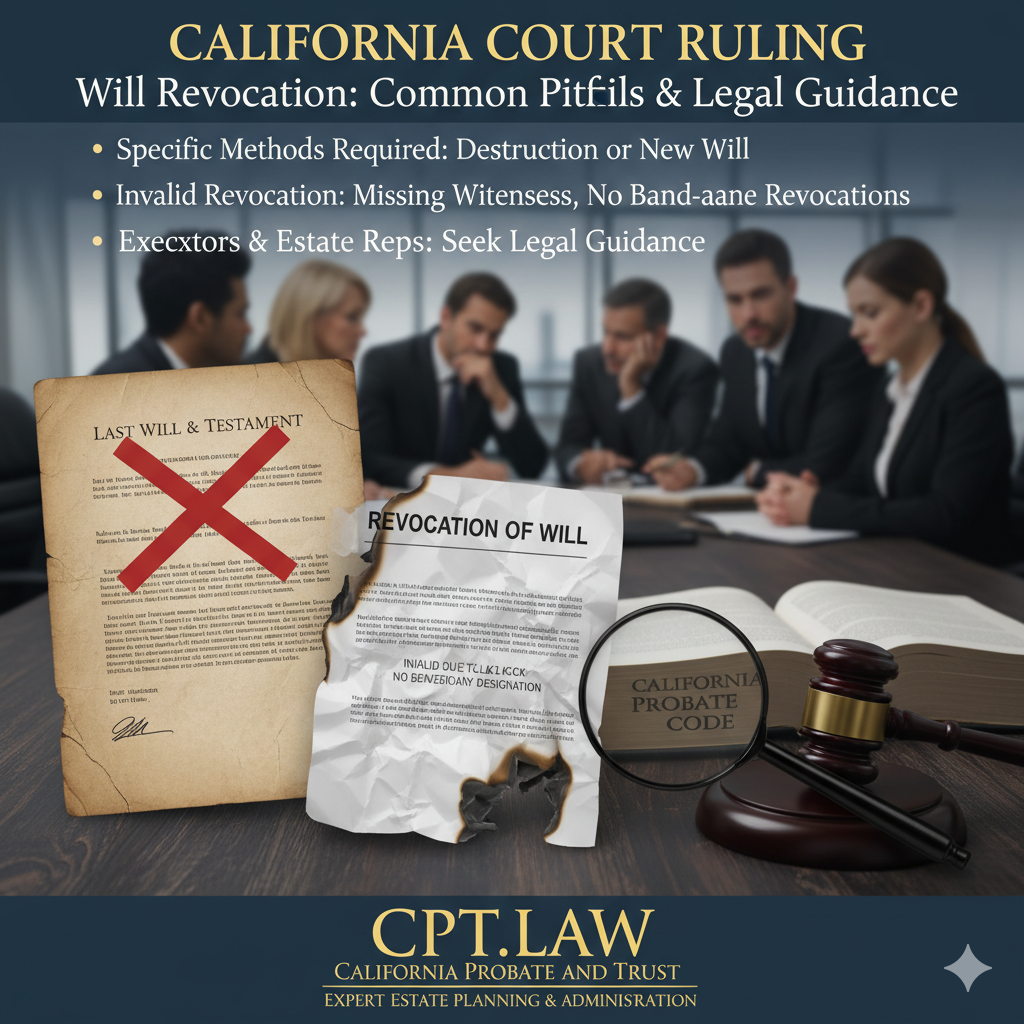
- No beneficiary designation or property transfer. The document didn’t transfer any property or designate any beneficiaries, which California law requires for a valid testamentary instrument.
- Missing witness formalities. The document lacked the two witnesses required under Probate Code section 6110(c)(1) for a witnessed will.
- California rejected the “harmless error” rule. Unlike some states following the Uniform Probate Code, California intentionally did not adopt provisions that would excuse technical defects in stand-alone revocations.
- No California precedent supports stand-alone revocations. The court found no California case law validating a stand-alone will revocation that didn’t also make dispositions upon death.
Real-World Impact: What Executors Need to Know Right Now
Scenario 1: You discover a handwritten note saying “I revoke my will”
This type of document is almost certainly invalid under Boyajian unless it also contains instructions for estate distribution or the physical will was destroyed.
Scenario 2: The decedent wanted to distribute their estate by intestacy
The court noted that simply including language like “distribute my estate by intestacy,” “my children should share equally in my estate,” or “distribute my estate according to law” would have made the 2018 document valid.
Scenario 3: You’re concerned about personal liability
As an executor, incorrectly determining which will is valid can expose you to personal liability. The Boyajian ruling provides clear guidance: without proper formalities or physical destruction, a simple revocation statement cannot cancel a prior will.
How to Properly Revoke a Will in California: Step-by-Step Guidance
Method 1: Physical Destruction
Method 2: Execute a New Will
Common Questions Executors Ask About Will Revocation
Can I rely on a document that says “I revoke all my wills and want intestacy to apply”?
After Boyajian, if the document includes language directing distribution according to intestacy laws, it may qualify as a valid will that revokes prior wills. However, it must still meet execution formalities (witnesses or holographic requirements).
What if the probate court already ruled on the validity of a revocation?
The Boyajian case shows that even when a probate court finds “clear and convincing evidence” of intent to revoke, appellate courts will reverse if statutory formalities weren’t met.
Does the testator’s capacity matter if formalities aren’t met?
While California law requires the same capacity standard for revoking a will as for creating one (Probate Code section 6124), capacity alone cannot overcome defective execution formalities.
Why This Ancient Law May Need Updating—But Remains Binding
The court acknowledged that requiring physical alteration for cancellation “is an ancient concept, perhaps in need of revisiting”. The requirement traces back to England’s 1677 Statute of Frauds and California’s 1898 Estate of Olmsted decision. However, until the California Legislature changes the law or courts establish new precedent, these strict formality requirements remain binding on all executors and estate administrators.
Protect Yourself and the Estate: Professional Guidance for California Executors
If you’re serving as an executor or personal representative and encounter questions about will validity or revocation, professional legal counsel is essential. The experienced probate attorneys at California Probate and Trust have guided thousands of California executors through complex estate administration challenges, helping them fulfill their duties while avoiding personal liability.
We Can Help With:
- Determining which will is valid when multiple documents exist
- Assessing whether a purported revocation meets California’s legal requirements
- Navigating contested probate proceedings when heirs dispute will validity
- Protecting you from personal liability as an executor or trustee
- Administering estates efficiently while complying with all California probate laws
Schedule Your Free Consultation
Don’t navigate complex will revocation questions alone. Our certified estate planning specialists offer free consultations to assess your situation and provide clear guidance on your duties and options.
Contact California Probate and Trust today:
- Call (866) 674-1130 for immediate assistance
- Schedule a free consultation at our Fair Oaks, Sacramento, or San Francisco offices
- Visit cpt.law to learn more about our probate administration services
Source: CEB Articles, “The Revocation That Wasn’t: Fourth District Requires That Written Revocation Make Bequest for Validity” by Bruce A. Last, published August 4, 2025
The information in this article is based on Estate of Boyajian (July 3, 2025, G063155) and is intended for educational purposes. For specific legal advice regarding your estate administration duties, consult with a qualified California probate attorney.
