


Andy Carter’s latest listing on the Long Beach peninsula has it all: four stories, ocean views, even a private elevator. But when the house hit the market for $4.95 million in August, it couldn’t find a buyer.
Turns out, the missing piece was a red tag deeming it unsafe for occupancy.
After Tropical Storm Rachel battered the oceanfront home in October, sending waves crashing into the living spaces, the sellers decided to keep the property on the market, but with a new price tag: $2.9 million. Now, buyers are swarming.
“I’ve been getting five to six calls per week from developers,” Carter, a real estate agent with Fiv Realty Co., said, adding that two developers already made offers.
When the home relisted on Oct. 14, it featured a new line at the top of the listing description: “Property has been RED TAGGED and is LAND VALUE.” It sent developers into a tizzy.
Carter said developers and builders he has spoken to are looking to purchase as many homes as possible that were damaged by the storms.
“There’s a big market for it,” he said. “It’s an interesting property to pencil if you’re planning to sell it. It depends on if you can save the home or scrap it and rebuild.”
Carter said 70% of the house is salvageable. There’s a crack in one of the home’s two foundations, and interior damage from waves breaking into the lower levels.
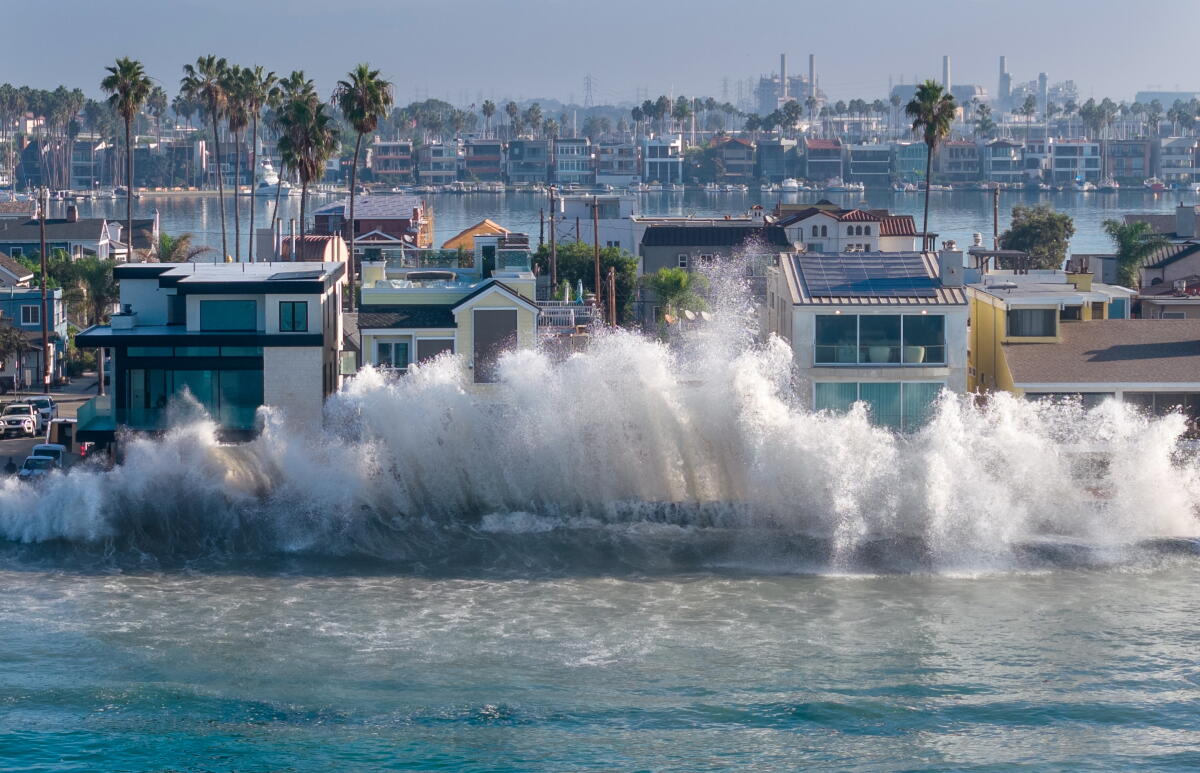
Waves pound homes on the Long Beach peninsula.
(Allen J. Schaben/Los Angeles Times)
It’s a strange market, Carter said. High interest rates are keeping many buyers at bay, and the threat of more damage from a potentially historic El Niño this winter is causing further fear.
The disaster market — when real estate speculators scoop up properties in the wake of a disaster — happens quite often in Southern California, a region battered by fires, earthquakes, landslides and floods. Last year, Altadena’s burned-out lots were flying off the shelves in the wake of the Eaton fire.
But it’s potentially a bigger gamble to buy up homes along California’s eroding coastline, which experts say is in danger given the forecast of a super El Niño in the months to come.
However, with the state of the housing market — high interest rates and soaring construction costs — many developers have stopped building altogether. Profit margins are too tight for many projects to make sense, so the only way a project can pencil out is if the initial investment is lower.
That means for some, buying a flooded-out, red-tagged house potentially in danger of even further damage might make sense — at the right price.
It’s too early to tell what that price will be; Carter’s listing is the only flooded home on the Long Beach peninsula on the market. Though with intense interest from investors, more likely will follow.
“Some buyers are hitting pause,” Carter said. “But others see opportunity.”
